
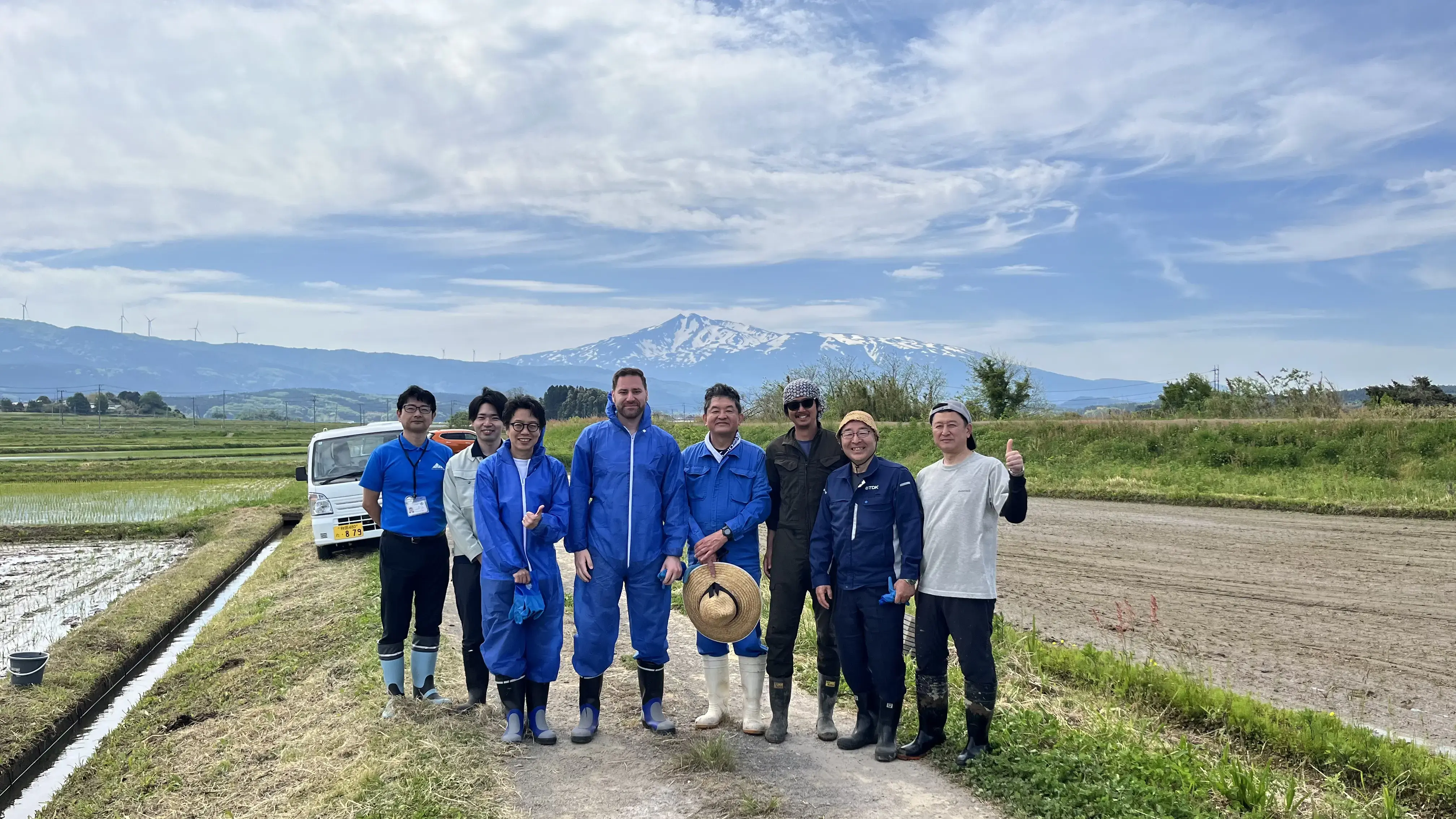
Nikaho, Akita · May 2026
A planting tractor in northern Japan, one farmer quote, and three lessons that shape how we build Greenda. What does the future of farming look like in Japan ? Greenda went looking for answers in an unexpected place: a rice paddy in Akita, northern Japan.
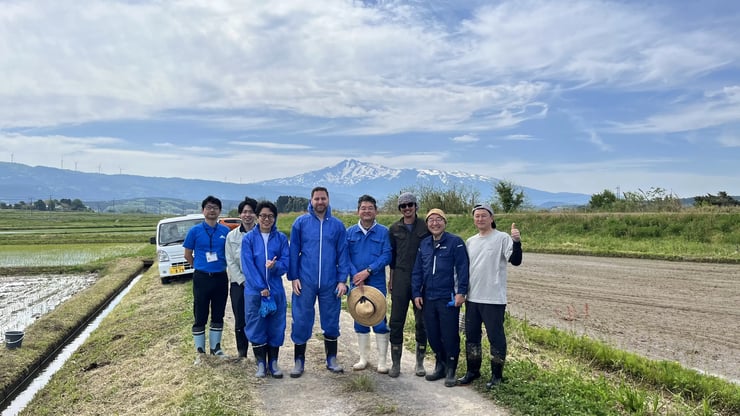
Nikaho, Akita · May 2026 The planting-day team, Mount Chōkai behind. [Kumagai Yū (熊谷 悠) & Mitome Eisuke (熊谷 悠) from Dept. of Agriculture, Forestry & Fisheries, Agricultural Promotion Section (Konoura Office), Nobumitsu Kanemori (TDK Incubation Center, Technology & Intellectual Property HQ), Chadi Nemr (Greenda), Taira Sasaki & Satoshi Murakami (TDK Agrisolution Section, Administration HQ).
Our CEO and co-founder Chadi Nemr rode a planting tractor alongside the farmers who work this fertile land and came back with convictions that have since shaped conversations across our entire team.

01 - Japan in 2026
Japan's farming landscape: Fewer hands, sharper tools
To understand what our team took from Akita, it helps to understand the moment Japanese agriculture is in. The headline numbers are striking.

A workforce transformed
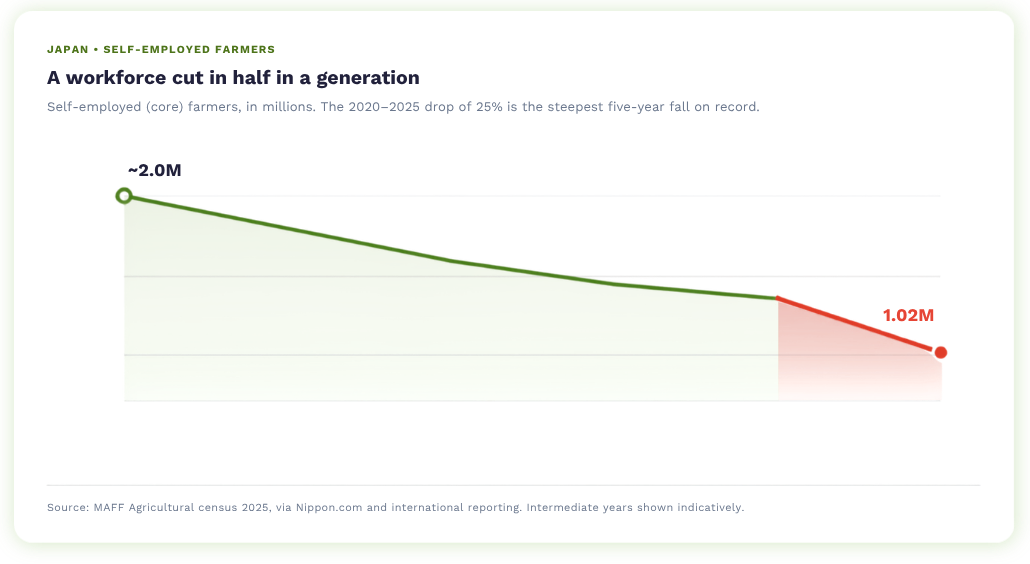
Japan's latest agricultural census, released at the end of 2025, recorded the largest five-year decline in self-employed farmers ever measured: down 25% to roughly 1.02 million people (about half the number at the turn of the millennium). Around seven in ten core farmers are 65 or older, and the average age hovers near 68. Fewer than a third of farm operators expect to secure a successor within five years.
How Japan is responding
What struck us most is not the challenge, it's the response. Rather than treating the demographic shift as a decline, Japan is treating it as an invitation to do things differently:
- Automation in the paddy. GPS-guided tractors, robotic transplanters, and automated harvesters are now widespread, reducing manual labour on key operations by an estimated 30–50% and helping experienced growers stay productive longer.
- Controlled-environment growing. Japan leads the world in plant factories and high-tech greenhouses, expanding even as the number of growers falls.
- Deep cooperation. Farmers, public agriculture offices, and industry partners work the same problems side by side, something Chadi witnessed first-hand, with TDK supporting local farms in Akita while the farmers retain full ownership of their land and decisions.

Every good field trip starts indoors. Chadi's began at TDK's offices in Tokyo, meeting the people shaping how a global technology company engages with agriculture.
A surprise in a school textbook
One detail from Tokyo stuck with everyone back in Munich: TDK's agricultural technology work is featured in a junior high school science textbook from one of Japan's leading educational publishers. In Japan, farming innovation isn't a niche topic; it's something the next generation learns about in school.

02 — The rice economy
A masterclass in Japan's rice economy
Before heading north, Chadi received what the team back in Munich later called the best explanation of Japanese agriculture heard in two and a half years of asking: a structured walkthrough of the rice economy from TDK's agri-solutions team, led by Murakami-san of TDK's Agri Solution section.
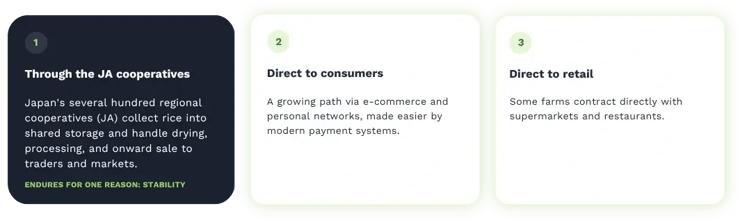
Three roads from paddy to plate
Japanese rice reaches consumers along three routes and most farmers blend them.
A culture of voluntary responsibility
Perhaps the most striking feature of the system: much of Japan's on-farm quality practices run on voluntary reporting. Farmers log the crop protection and fertilizer they use and report it to their cooperative — not because an inspector demands it, but because that's how the system works. Trust is the enforcement mechanism. TDK's own local staff have even trained and certified as inspectors to support quality verification in the region.
Why this floored a European visitor
In Europe, we tend to assume good practice requires regulation. Japan's rice belt runs, to a remarkable degree, on professional pride and mutual trust.

North to Akita: Rice country at the foot of Mount Chōkai
From Tokyo, the journey went north to Akita Prefecture, Japan's deep rice country, where flooded spring paddies mirror the sky and Mount Chōkai, still snow-capped in May, watches over everything. The local team's pride in their mountain is well earned; once you've seen it rising over the fields, you understand why.
Phi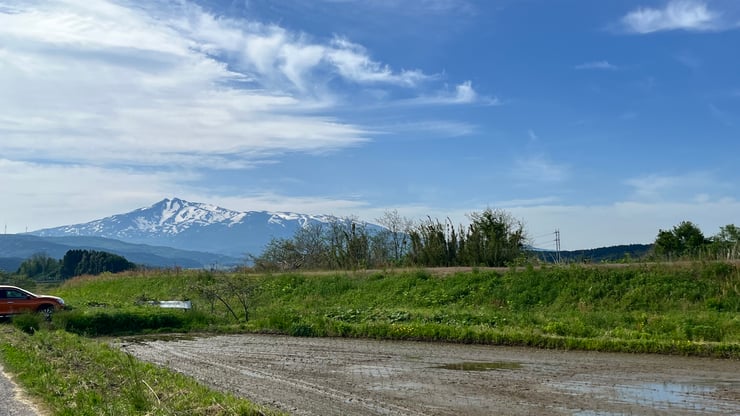
Photograph taken by Chadi Nemr during Mount Chōkai trip
Nikaho: Where industry and agriculture grew up together
Chadi's base was the Nikaho area, a place with a special relationship to TDK. The company has deep roots and major facilities here, and the connection runs through families: TDK engineers whose parents farm rice, and farmers who spent careers at TDK. Agriculture and industry aren't separate worlds in Nikaho. They're the same community.
Then came the part no boardroom can teach. At the invitation of local farmers, Chadi joined rice planting; not watching from the bund, but on the machine.
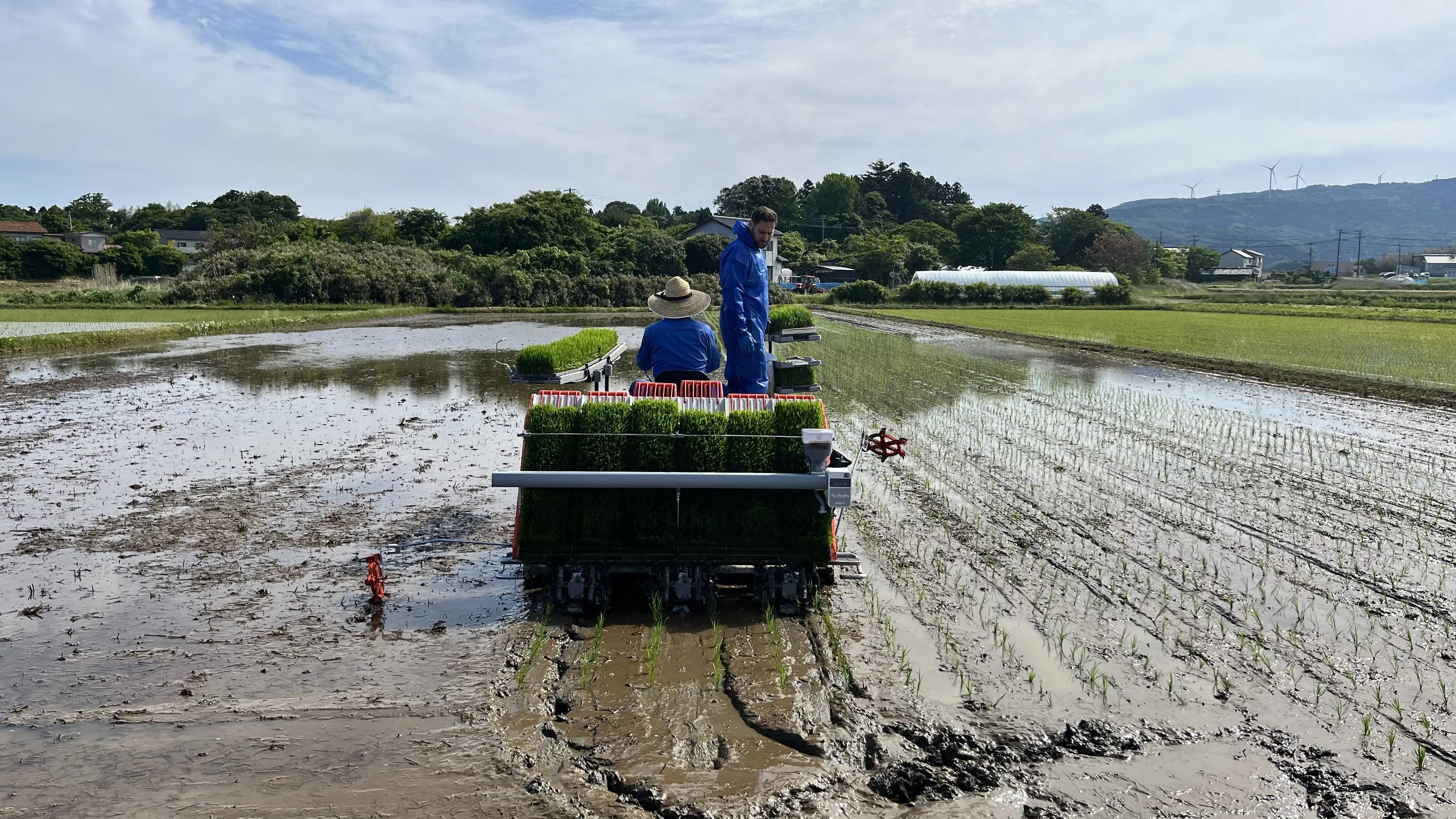
Nikaho, Akita · May 2026 Chadi on the transplanter
Riding the transplanter
The rice transplanter carries dense green mats of young seedlings, raised in nursery trays until their roots weave into a living carpet. As the machine moves through the flooded paddy, it sets the seedlings into the mud in immaculate rows and dispenses a small white granule of crop protection alongside, in the very same pass, directly into the water.
No separate spraying run. No extra trip through the field. Protection, built into the act of planting itself.
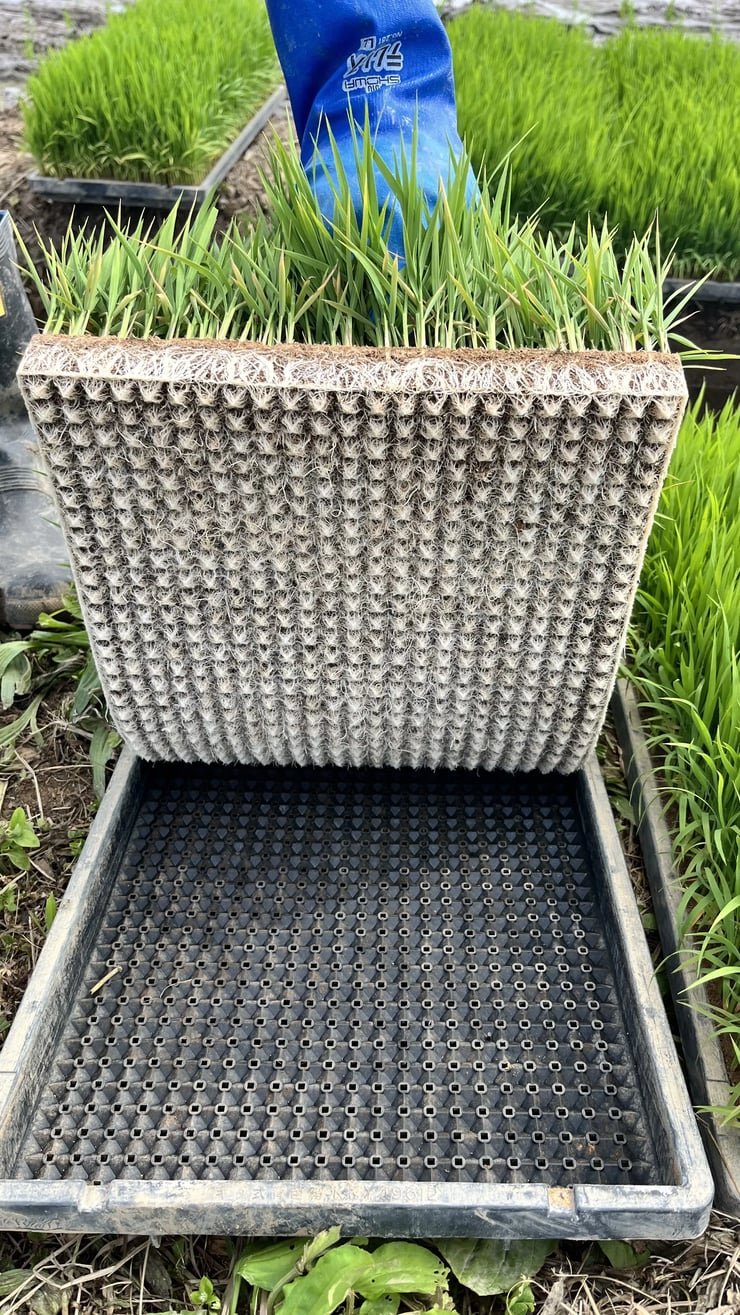 A seedling mat lifted from its nursery tray, roots woven into a living carpet.
Why this detail matters
It's the most elegant expression of a philosophy Chadi heard again and again that day: farmers there judge everything, machine, method, or granule, by one standard.
Not anti-technology. The opposite: they adopt advanced tools readily, when the result earns it. The burden of proof sits with the technology. As it should.

The award-winning entity: Akata Farm
The second visit was to Akata Farm in Yurihonjō, a multi-generational family operation that formed a farmers' union 18 years ago and incorporated five years later. Today it farms 43 hectares: 33 of rice, 10 of soybeans, plus greenhouse asparagus, and its rice has won prizes at regional quality contests in consecutive years.
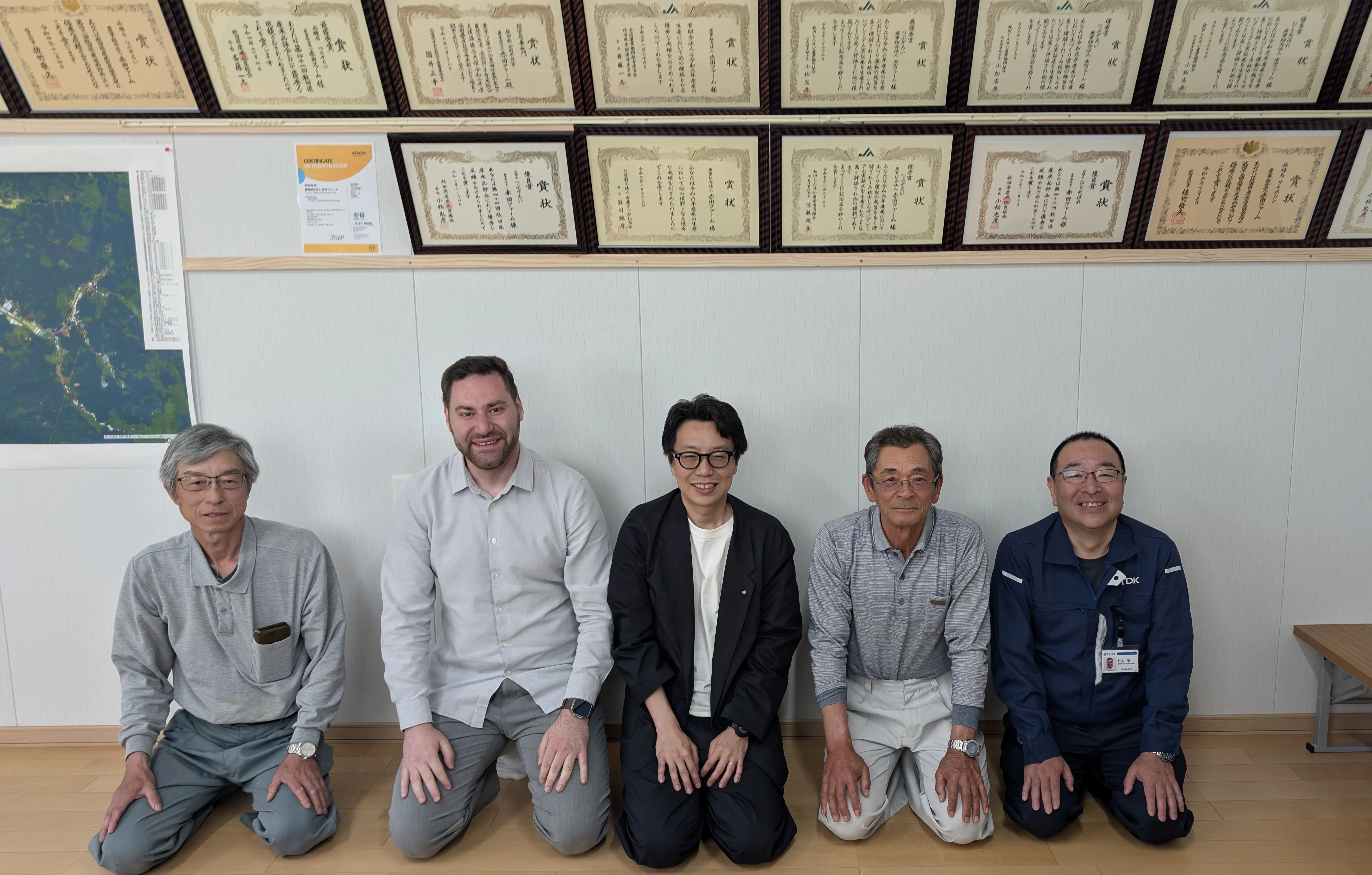
Akata Farm, Yurihonjō · May · 2026 Beneath a wall of regional quality awards earned in consecutive years (Itō Kimio and Itō Akitoshi from Akata Farm, Nobumitsu Kanemori and Satoshi Murakami from TDK & Chadi Nemr from Greenda)
Scale, technology, and the same restraint
Akata Farm sells about 80% of its harvest through the JA cooperative for one beautifully simple reason: payment stability. The co-op guarantees the sale, shares growing expertise, and even advises on business management. The farm embraces technology, from camera-equipped drones to mechanized equipment, with machinery investments supported by subsidies and a clear-eyed view of the trade-offs. In their words, technology does not increase the harvest; it reduces workload and cost. And their crop protection? Typically once per year. Twice at most, in years when the cooperative's alerts signal higher pest pressure, with dosage strictly by the book.
Conversations with Farmers: What We Heard in the Field
Alongside the farm visit, Chadi sat down with several local rice farmers to understand how they work, what they worry about, and how they make decisions. These were honest research conversations, and across every one, the same themes surfaced.
How farmers actually make pest decisions
The most striking pattern came when Chadi asked how farmers respond to pest pressure. Every conversation described the same rhythm and one farmer put it in the clearest terms he'd heard all trip:
"I need to check and see if that pest exists in my field. And if I find it, I will do something about it. But if I don't find it, I'm not going to do anything."
- Rice farmer, Nikaho, Akita
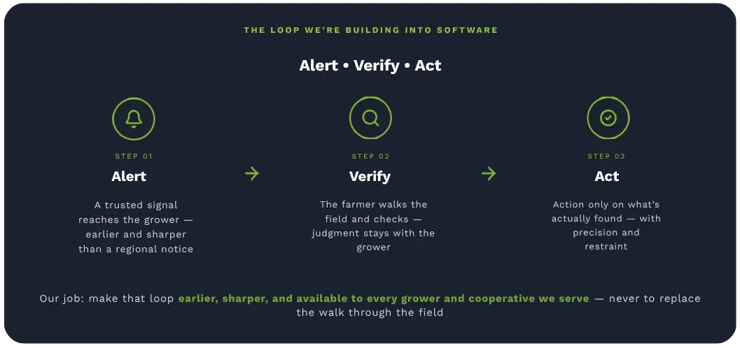
No spraying on assumption. No blanket application. The cooperative sends a regional alert; the farmer walks their own field; they act only on what they actually find. Eyes on the ground, every time.
Restraint as a professional standard
What surprised us was how minimal the chemical inputs were across the board — across farms of all sizes and approaches. Pesticide applications counted in single digits per season; some farmers measured their interventions over decades, not years. One described his entire farming philosophy in a single line:
"Just leave it up to them, them being the plants. That's the base."
This wasn't ideology. It was craft: knowing your field, trusting your cooperative's alerts, and acting only when the evidence in front of you demands it.
What Japan Trip Confirmed for Greenda
Chadi came home with a notebook full of details and three convictions, now shared across our team. Here are the top three learnings from the trip:
1. The alert-verify-act loop is universal, and it's our blueprint
Japan's cooperatives already operate a human-powered early-warning network for pests: observe regionally, alert members, let each farmer verify and respond. It works because it respects the farmer's judgment.
2. Technology earns its place or it doesn't
From the transplanter to the drone, every technology Chadi saw in Akita had earned its place by outcome, not novelty. We hold ourselves to the shovel-versus-robot standard: prove the result first. Across operations of very different sizes, farmers held the same standard: a tool justifies itself by what it delivers, not what it promises. Those who had adopted technologies such as drones, mechanised equipment, and precision seeding were clear that it reduced workload and costs, but didn't automatically increase yield. The return on investment was in labour saved, not magic results.
3. Trust scales through cooperatives
From the JA network to the five-party Nikaho partnership, every durable structure Chadi saw had a cooperative or a coalition at its core. That mirrors exactly how we work in Spain, with cooperatives as the trust layer between technology and the field.
Sources & notes
- Companion statistics post (Japan vs. Europe) carries the MAFF and Eurostat citations.